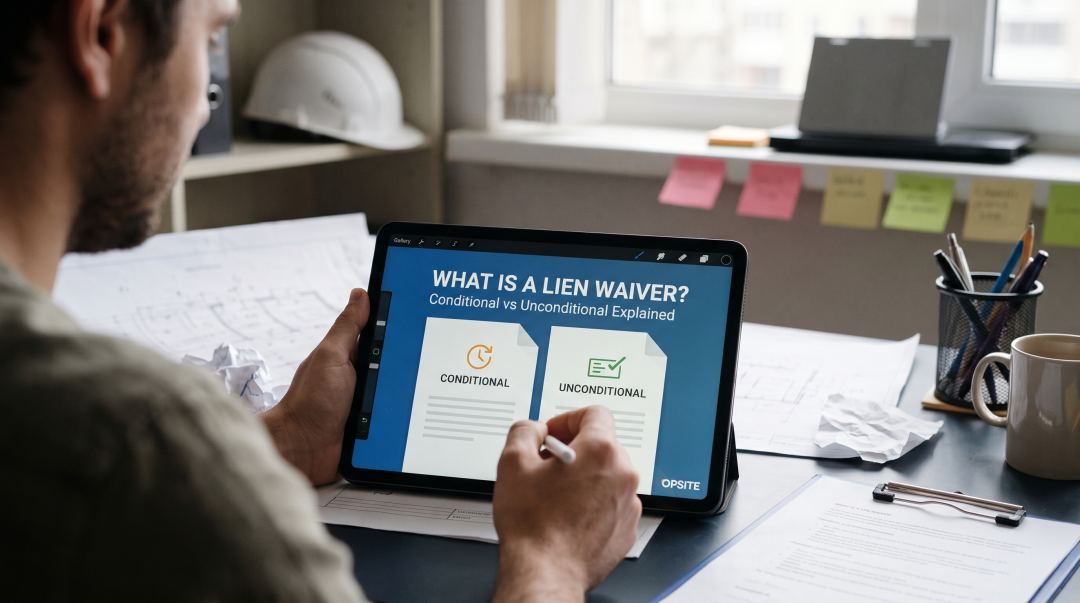
Signing the wrong lien waiver at the wrong time can cost you money you already earned. Here’s when to use conditional vs unconditional waivers, what to check before you sign, and why “payment’s coming Friday” isn’t payment.
What Is a Lien Waiver? Conditional vs Unconditional Explained
Before you sign a lien waiver, or ask anyone else to, answer one question: has the money actually landed? Not promised. Not "in the mail." Landed. Most waiver mistakes trace back to fudging that answer.
If you came here for the conditional vs unconditional breakdown, it comes down to three things: when the release kicks in, which rights it covers, and what proof of payment backs it up.
The Short Answer: A Lien Waiver Releases Defined Payment Rights
A lien waiver is a signed document where a contractor, sub, supplier, or materialman gives up certain rights (to file a mechanic's lien, make a bond claim, or press a payment claim) in exchange for payment, or in expectation of it. That's roughly how Asmar, Schor & McKenna's lien-waiver guidance frames it. What it actually does depends on the form and the law where the project sits.
Here's what trips people up. A waiver covers one payment from one claimant. It does not prove everyone on the job got paid. GCs, owners, lenders, and title companies collect waivers during draws and closeout to keep claims from clouding the owner's property title later. A waiver only does that job if it ties back to the right draw, the right claimant, and real payment evidence.
What a Complete Waiver Should Identify
At minimum: the claimant, the payer, the payee, project name and address, job number, payment amount, payment period or waiver cutoff date, and exactly which rights are released. An invoice or purchase order reference makes life much easier when you're matching paper to money six months later.
Then look at the exceptions. Retainage. Disputed amounts. Pending change orders. Future work. If they aren't carved out in writing, assume they're gone.
Lien waiver review is tedious. It's also the part that protects you. Software can organize the paperwork, but someone still has to read the scope.
Conditional Lien Waivers: Protection Until Payment Clears
A conditional waiver only takes effect once its condition is met, usually that payment is received and clears. Contracts Connected's state-by-state guide describes it this way: lien rights are released when the referenced payment clears the bank. Use one when payment is promised, a check has been issued, or a transfer is still pending.
"Upon receipt of payment" is the phrase doing the heavy lifting. Sign conditionally, get a bounced check, and you haven't given anything away. Still, read the actual condition. Don't trust the title printed at the top of the form.
When a Conditional Waiver Fits the Draw Cycle
A conditional progress waiver goes with a progress pay application before funds clear. A conditional final waiver goes with the final pay app while final payment is still outstanding.
One more thing: a waiver doesn't replace a required preliminary notice or notice to owner. Different document, different deadline.
What to Verify Before Signing
Match the amount, period, exclusions, claimant, and authorized signer to the invoice. Keep the payment receipt and a timestamped record of the signed copy. When a dispute shows up, "I think we sent it in March" won't carry much weight.
Unconditional Lien Waivers: Effective When Signed
Unconditional waivers release lien rights the moment they're signed, whether the money arrives or not, according to Contracts Connected's lien-waiver requirements guide. State law can affect enforceability. Don't count on that to save you.
So if the check bounces or the transfer fails, you may have signed away your leverage for nothing. Of everything on this page, this is the mistake that costs the most.
Sign unconditional only after you've confirmed receipt and the funds are actually available. A developer saying "it's coming Friday" is not payment.
When an Unconditional Waiver Fits
Unconditional progress waiver: after that specific progress payment clears. Unconditional final waiver: after final payment, including agreed retainage, is in hand and the release scope is correct.
Don't sign early just because someone's draw checklist needs a box ticked.
Why Unconditional Forms Need Extra Review
Watch for broad release language, cutoff dates, exclusions, and anything that releases claims beyond lien rights. A payment milestone doesn't define the scope. The words on the page do.
Look hard at references to claims, changes, retainage, and work outside the stated payment period. Some forms carry boilerplate that reaches further than the label suggests, even on something called a partial waiver. Older forms sometimes say they're executed "under hand and seal." It sounds official. What matters is still what's being released, so read past the ceremony.
And a payment waiver isn't the same as removing a lien that's already been recorded. That's a separate process.
Conditional vs. Unconditional Lien Waiver Comparison
Rule of thumb: conditional before verified payment, unconditional after. Neither should release more than you intended under the governing law.
California's statutory release forms show the split clearly. Other states handle it differently.
| Feature | Conditional Waiver | Unconditional Waiver |
|---|---|---|
| Effective date | When the stated payment condition is met | Generally upon signing |
| Ideal payment status | Pending or uncleared | Received and verified |
| Primary risk | Wrong conditions or scope | Releasing rights before payment |
| Common use | Before progress or final payment clears | After progress or final payment clears |
| Document handling | Link the signed form to later payment evidence | Verify payment evidence before signing |
A written acknowledgment of payment isn't the same as confirming funds cleared. A title company requiring the form doesn't change that either.
The Four Common Lien Waiver Types
Many states sort waivers by payment condition and stage. California spells out four statutory forms. Treat them as an example, not a template that works everywhere.
Conditional Waiver and Release on Progress Payment
A partial waiver for a progress payment that's still pending. Its effect follows the stated condition, the through date, and the exceptions, not just the dollar amount.
Unconditional Waiver and Release on Progress Payment
Use after a progress payment is received. Check the exclusions for retained amounts and unpaid work.
Conditional Waiver and Release on Final Payment
Use while final payment is pending. It takes effect once the stated condition is satisfied.
Unconditional Waiver and Release on Final Payment
Use after final payment is confirmed. Slow down on this one. It may wipe out whatever lien rights remain for the described work.
Get legal advice for nonstandard forms, public projects, payment bonds, or anything in dispute.
Choose the Right Waiver for the Payment Status
Three questions. Progress or final? Has it cleared? Any unpaid exceptions?
Then figure out who should actually sign, and at which tier. A subcontractor's waiver doesn't prove its supplier got paid, a point the California Contractors State License Board makes directly.
Every waiver should map to a specific payment event: a draw, a check, a transfer. If you can't name the event, you're not ready to sign.
Use Conditional When Payment Is Pending
Mailed check, pending transfer, unconfirmed payment: go conditional. Match the amount and period to the invoice or pay application.
Joint checks and payment bonds can need extra documentation and a jurisdiction-specific look.
Use Unconditional Only After Payment Is Verified
Confirm payment evidence and list disputed extras as exclusions before you sign. Contract review software won't prove the funds cleared. Neither will a signature timestamp.
Keep the backup records with the waiver in whatever document system you use.
Build a Waiver Chain, Not a Folder of Signed PDFs
A folder of signed PDFs isn't lien waiver management. If you're a remodeler running several jobs, you need a waiver chain that follows the payment chain. Build each job's claimant list from executed subcontracts, purchase activity, notices, and known suppliers.
Then track each waiver against its job, draw, claimant, payment status, approval history, and payment evidence. Waiver collection falls apart the moment it lives in one person's inbox. Automatic reminders help. Someone who actually owns the process helps more.
What General Contractors Need to Confirm
Claimant identity, signing authority, job number, payment match, release scope. A prime contractor's or sub's release doesn't erase separate lower-tier rights, and that gap is where most of your rights exposure sits.
A Quick Word on Tools
You'll run into a lot of names researching this. Levelset, Lienguard, NCS Credit, Beam, Constructable, Corpay, and SunRay Construction Solutions all come up in conversations about waiver collection, payments, or lien compliance. Document Crunch comes up for contract review, BoldSign for e-signatures, NotaryHub365 for online notarization. A waiver generator can produce a clean form in seconds. None of them reads your scope language for you. Use what fits, but keep the judgment in-house.
How Opsite Supports a Defensible Payment Record
Opsite was built by a contractor with real residential remodel and subcontractor-management experience. It connects jobs, draws, invoices, subcontractors, compliance, and client records in one place, and its zero-login subcontractor portal works in English and Spanish.
In a demo, you can trace job-linked records for labor and materials through approval routing, payment evidence, reminders, and workflow history. Confirm the plan and setup that match your workflow, and keep using whatever form your jurisdiction requires.
To be clear: Opsite organizes the record. It doesn't decide whether a waiver is legally enforceable.
State Rules, Form Language, and Legal Review Matter
Lien waiver laws vary a lot. Contracts Connected counts ten states that prescribe a waiver form in statute, while most others treat a waiver as an ordinary contract document. Where statutory language exists, don't improvise on it. And don't assume a form that works in Illinois will work in Nebraska or Wisconsin.
Some states also require notarization on certain waivers. Check that before assuming a signature alone is enough.
Mechanics lien rights on private property aren't the same as payment bond rights on public projects. Federal jobs may fall under the Miller Act; state public jobs under statutes usually called Little Miller Acts. On bonded work the surety is part of the picture, and a waiver can affect claims against the bond, not just the property.
Talk to a qualified construction attorney about unusual releases, fraud or serious pressure to sign, disputed extras, insolvency risk, or multi-state projects. Look for someone who handles construction payment work regularly, not a generalist. Grzymala Law Offices and Miller, Ross & Goldman are two names contractors run into when they go looking.
California Is a Useful Example, Not a Universal Template
California provides four statutory waiver and release forms tied to progress and final payments. Check local requirements before reusing a California template anywhere else.
E-signatures are generally recognized under the federal ESIGN Act and state UETA laws. That doesn't fix wrong terms, though, and notarization or specific execution requirements can still apply.
The Practical Verdict: Match the Release to Real Payment
Conditional waivers protect your rights while payment is pending. Unconditional waivers generally give them up the moment you sign. GCs should collect the right release from every potential claimant, tie it to the right draw, and keep the payment proof alongside it. That's the whole job.
When Should You Use a Conditional vs. Unconditional Lien Waiver?
Use a conditional waiver when payment is pending or hasn't cleared. Use an unconditional waiver only after the stated payment is received and verified, and confirm whether it's a progress or final payment.
Frequently asked questions
When Should You Use a Conditional vs. Unconditional Lien Waiver?
Use a conditional waiver when payment is pending or hasn't cleared. Use an unconditional waiver only after the stated payment is received and verified, and confirm whether it's a progress or final payment.
What Are the Four Types of Lien Waivers?
Conditional progress, unconditional progress, conditional final, and unconditional final. Check the project's jurisdiction, because required forms and enforceability rules vary.
What Is the Difference Between Conditional and Unconditional?
A conditional waiver takes effect when its stated condition, usually cleared payment, happens. An unconditional waiver generally takes effect when signed, which is risky if the payment later fails.
What Is the Purpose of a Conditional Waiver?
It lets a claimant document an expected payment without giving up the related lien rights right away. The release only takes effect once the stated payment condition is met.